FMEA Explained: The Method Most Engineers Fill In Wrong
FMEA finds how a design can fail before it does. Here is the one line the whole method repeats, why its famous risk number buries the failures that matter most, and the three habits that make most FMEAs catch nothing.
Problem
Most engineers meet FMEA as a spreadsheet somebody emails them the week before a design review. You fill in the boxes, work out the score and send it back, and the design ships exactly the way it was always going to ship. The form catches nothing, and the method is not the reason. By the time the spreadsheet arrived, each decision it was meant to shape had already been made. A signed sheet that says the risk was reviewed is then worse than no sheet at all.
Quick Answer
The short version
FMEA, failure mode and effects analysis, is a structured way to find how something can fail before it fails, so the worst problems get fixed while they are still cheap, on paper, instead of expensive, in the field. You break a design or a process into what each part is supposed to do, and for every function you ask how it could fail. Each answer is a failure mode, and each one gets three questions: what it does to the person downstream, how often its cause is likely to happen, and whether you would catch it before it leaves. Those answers tell you which failures to chase first. It only works run early, while a change still costs a conversation instead of a recall, and run as a group, because the person who designed the part is usually the last one to see how it breaks.
Deep Dive
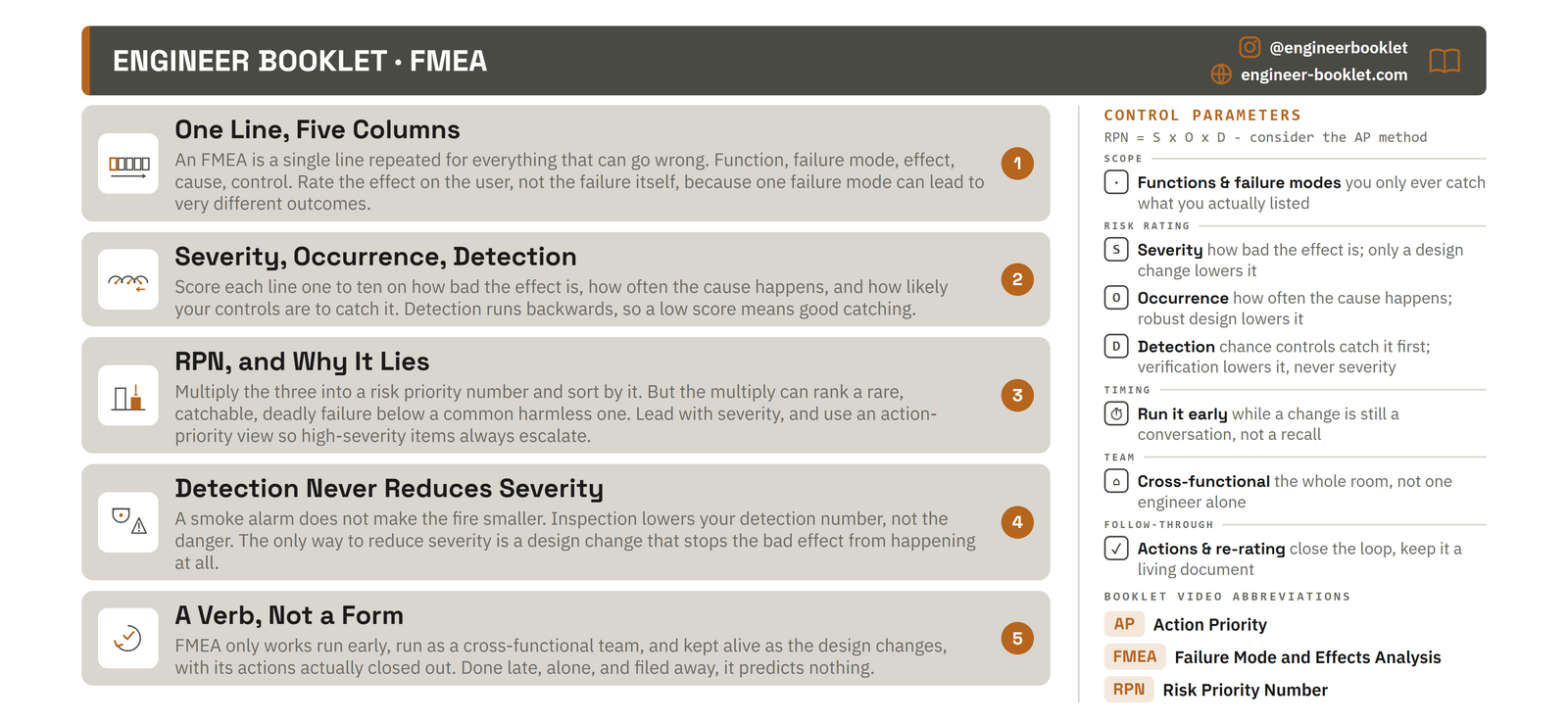
The method itself is one line, repeated. The video spends its time on the number that ranks those lines, where that number misleads, and the habits that decide whether any of it matters. The map: