Powder Bed Fusion (Metal 3D Printing) Explained
A laser melts metal powder layer by layer into a fully dense part. Here is the mechanism, the two ways the melting goes wrong, and why a part that looks perfect can crack weeks later.
Problem
You send a bracket out to be printed in titanium. It comes back looking perfect, smooth and dense, exactly the shape you modelled. Three weeks later it is in the field and it cracks along a line nobody predicted. Nothing about the geometry was wrong. The problem was baked in while the part was still being built, layer by layer.
Quick Answer
The short version
Powder bed fusion is a metal 3D printing process. A thin layer of fine metal powder is spread across a build plate, thinner than a sheet of paper. A laser, or in some machines an electron beam, melts the powder exactly where the part needs solid metal. The plate drops one layer, fresh powder is spread on top, and the laser fuses the new layer to the one underneath. Repeat that tens of thousands of times and a fully dense metal part has grown out of the powder, with no mould and no cutting tool.
Deep Dive
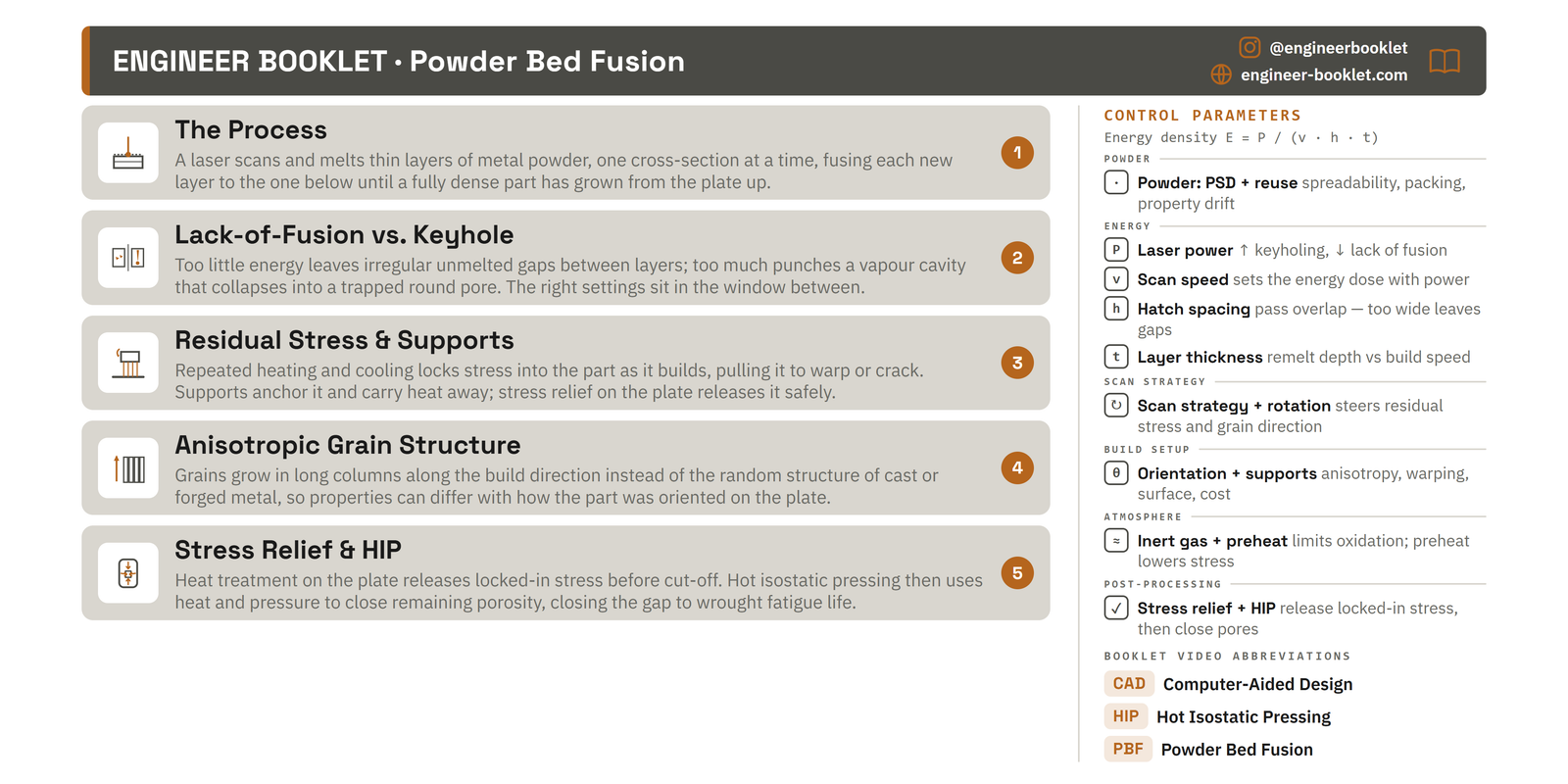
The build is the easy part. All that repeated heating and cooling is what changes the metal, and it is where the video spends its time. The map: