CNC Machining Tolerances: What's Actually Achievable
A tight number on a drawing is a budget you spend. What really sets the tolerance a machine can hold — the machine, the tool, the heat, the clamping and the number of setups — why the cost curve goes vertical as you tighten it, and the measuring floor underneath all of it.
Problem
You finish a design and, to be safe, you put a tight tolerance on every dimension. Then the quote comes back at roughly triple what you expected, with a lead time nobody planned for. Nothing on that drawing was impossible. The trouble is that every tight number was asked for at once, on features that never needed one, and each of them multiplied the cost of the whole part — because a tight number changes how that part has to be cut, held and checked.
Quick Answer
The short version
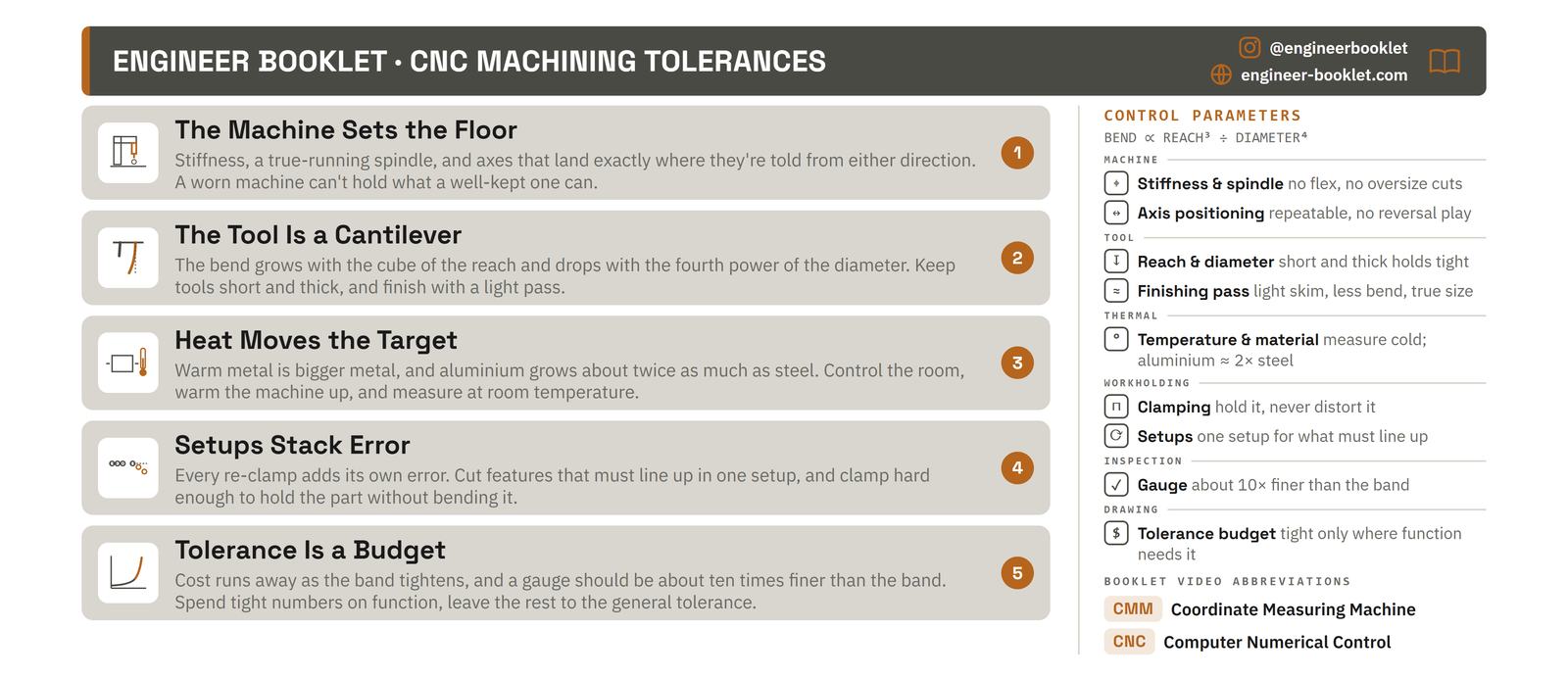
A tolerance is how far a real dimension is allowed to wander from the number on the drawing and still pass. No machine makes the same size twice, so a good part is one whose size lands inside the band you drew. How tight a band you can hold comes from five things working together: the machine, the tool, the heat, the way the part is clamped, and how many setups it takes. Loosen the band and almost any shop hits it in one pass; tighten it and you pay for finish passes, better fixturing, a controlled room and slower inspection, each step costing more than the last. And there is one hard floor — a tolerance tighter than you can measure means nothing, because you cannot hold what you cannot check. So what is achievable comes down to two questions: how much are you willing to spend, and does this feature really need it?
Deep Dive
Five things decide the band a shop can hold, and they work together rather than in turn. The video walks each one, then puts them all on a cost curve. The map: