Industrial IoT Sensors 101: How Factories Monitor Equipment
A cooling water pump runs for years, then its bearing seizes and the line stops, though the warning was there for weeks. What a factory actually measures on a machine, how each sensor works, where to mount it and how fast to read it, how the signal reaches a controller, and how to rank what the system raises: warning, alarm, trip.
Problem
A cooling water pump runs for years, and one night its bearing seizes and the whole line stops. The warning was there for weeks: the bearing was shaking harder long before it ran hot, and long before anyone could hear it. Your car lights a lamp when the oil pressure drops, but plenty of machines on a factory floor have no light like that. Bolting sensors onto every machine does not fix it on its own, because you get a flood of numbers nobody reads and alarms that go off so often people stop looking. The skill is knowing what a factory actually measures on a machine, and how to pick the few readings that warn you in time.
Quick Answer
The short version
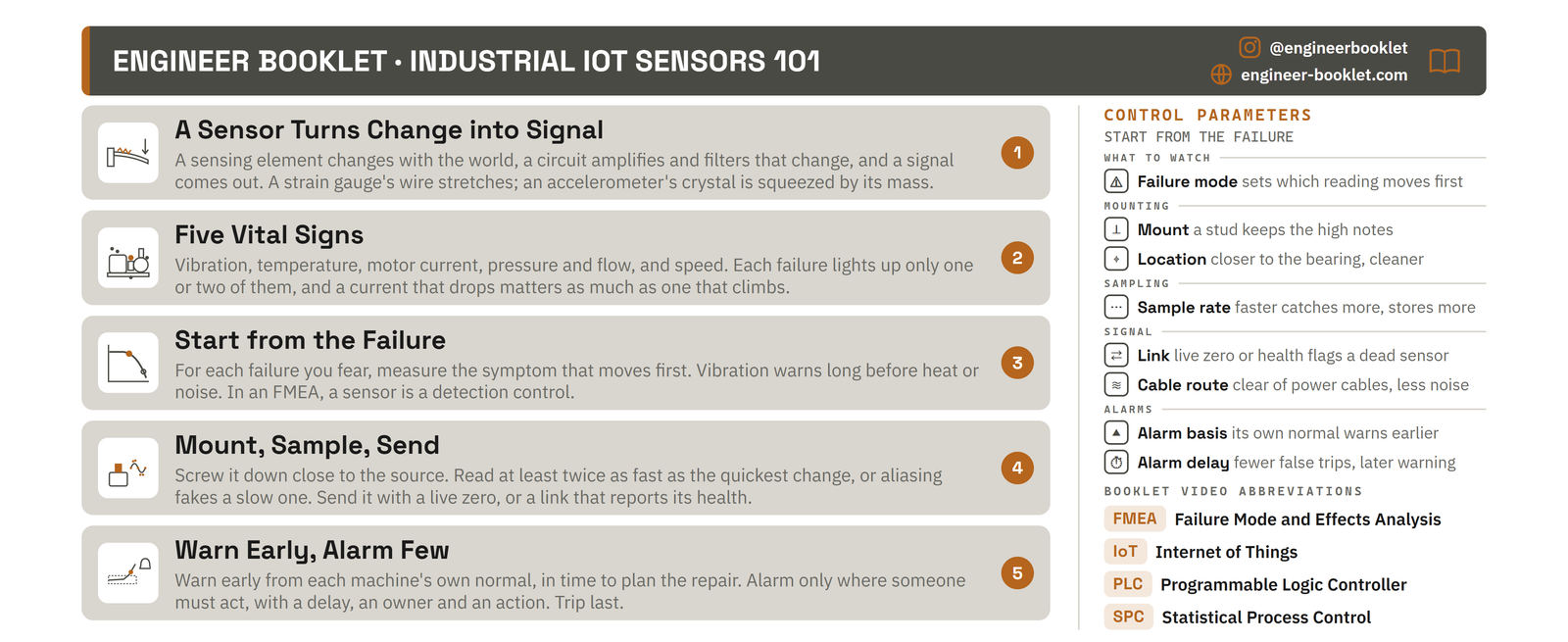
A sensor turns a physical change, like heat, shaking or pressure, into an electrical signal a computer can read. A factory watches a handful of vital signs on a machine: vibration, temperature, motor current, pressure and flow, and speed. The signal runs down a cable or radio link to a controller beside the machine, which can stop it within a fraction of a second, and copies of the readings go on to a server that keeps them for months. That networked part is what people mean by the industrial Internet of Things. The rule is to start from the failure you fear and work back to the sensor: each failure shows one symptom first, so measure that one. Mount the sensor where the symptom is strongest, read it fast enough to catch the change, then warn on a change from the machine’s own normal and alarm only where someone will act on it.
Deep Dive
A sensor is not a gadget bolted on for show. It is a way to hear a machine change before it breaks, and every choice after it, where it sits, how fast it is read, how the signal travels and when it raises a flag, decides whether the warning arrives in time. The map: